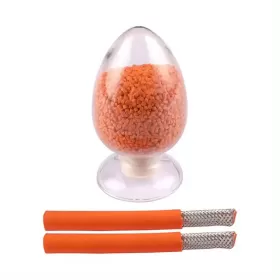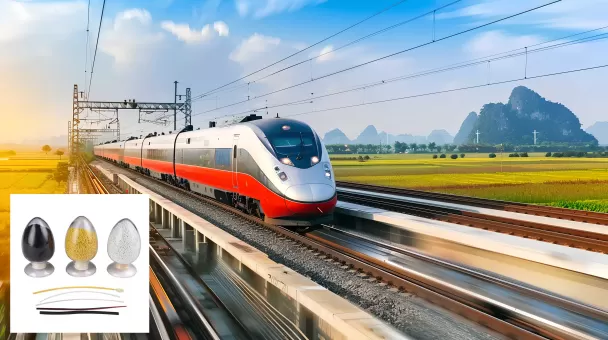
European standard locomotive cable materials are mainly low-smoke halogen-free flame-retardant polyolefin materials, which are often used in the manufacture of cables for high-speed railways, trains and subways in Europe and the United States. They comply with EN50264, EN50306 and other standards.
The Main Models And Products Are As Follows
| Locomotive cable material | ||
| European standard cable materials for locomotive cables | PFXBK92518 | Ultra-low temperature resistant and ultra-mineral oil and fuel oil resistant irradiation cross-linked low-smoke halogen-free flame-retardant polyolefin insulation material for locomotive wire |
| PFXBK92518H | Ultra-low temperature resistant and ultra-mineral oil and fuel oil resistant irradiation cross-linked low-smoke halogen-free flame-retardant polyolefin sheath material for locomotive wire | |
| European standard locomotive thin wall cable material | PFXBS97552 | Irradiation cross-linked low-smoke halogen-free flame-retardant polyolefin insulation material for locomotive thin-wall wire |
| PFXBS97552H | Irradiation cross-linked low-smoke halogen-free flame-retardant polyolefin sheath material for locomotive thin-wall wire | |
European standards (EN standards) have a series of detailed regulations for high-speed rail locomotive cable materials to ensure the safety and reliability of cables in high-speed rail locomotives. These standards cover the mechanical properties, electrical properties, heat resistance, oil resistance, chemical corrosion resistance, flame retardancy and environmental protection characteristics of cables.
The wiring in the European railway industry mainly follows these technical systems. Therefore, materials used in European locomotive cables must meet these technical systems and standard requirements:
① EN 50306 (Thin-walled locomotive and rolling stock wiring) Commonly used for internal wiring in locomotives and rolling stock. Key features include: Thin-walled and lightweight; High-temperature rating (typically 105℃/120℃); Oil-resistant, flame-retardant, low-smoke halogen-free; Strong stability in confined spaces. Common application models: EN 50306-2 / 3 / 4
② EN 50382 (High-temperature and high-voltage locomotive and rolling stock cables) Used in high-heat areas such as locomotive traction systems or near power units: Temperature rating up to 150℃-260℃; Uses high-temperature materials (XLPO, silicone rubber, PFA, ETFE, etc.); Suitable for traction systems, braking systems, and high-voltage wiring.
③ EN 50264 (Multi-core and medium-thick-walled locomotive cables) Suitable for medium-intensity scenarios in locomotives and rolling stock: Operating temperature typically 90-120℃; Oil-resistant and mechanical fatigue resistant; Common multi-core cable structure.
Common industry applications:
Vehicle interior control wiring (EN 50306): door control, HVAC, interior lighting, communication and signaling systems; Traction power wiring (EN 50306) 50382): Motor, inverter, braking system, power circuit; Undercarriage (high mechanical strength area): Rail vehicle connecting cables, undercarriage moving harness, oil-resistant area;
Material Systems (Insulation/Sheath) The following material systems are widely used in European locomotive wiring harnesses:
A. Cross-linked Polyolefin (XLPO)
Appears in standards such as EN50306 / EN50264.
Features: Lightweight, heat resistant 105℃–125℃, excellent electrical properties.
B. High-Temperature Cable Materials (Specified in EN50382)
Includes: Silicone Rubber/SiR, EPDM (cross-linked system), PTFE/PFA/ETFE/FEP (fluoropolymer)
Features: Temperature range 150℃–260℃, very high mechanical and electrical stability.
Applications: Located near high-heat areas such as engines, brakes, and traction converters.
C. Low Smoke Halogen-Free (LSZH)
Applications: Control lines, signal lines, and light-load power lines inside locomotives and rolling stock;
One of the core requirements of railways.
Commonly used materials: XLPO, LSZH flame-retardant polymer system;
Features: Extremely low smoke density during fire, no halogenated acid gases, excellent flammability (passes EN45545)
EN 50264 Series: Involving railway locomotive vehicle cables with special fire resistance, including single-core and multi-core cables with standard wall thickness.
EN 50306 Series: Involving thin-walled cables, including barriers and thin-walled sheaths for single-core and multi-core cables.
EN 50305: Specifies the test method for fire resistance of railway locomotive vehicle cables.
EN 50125 Series: Involving environmental conditions for railway equipment, including equipment on flatbed vehicles and fixed electrical installations.